
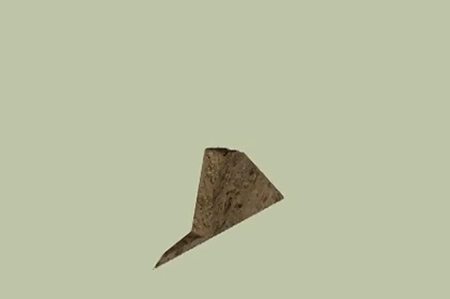
The wall’s wedge sectors were also assumed to be the same size in order to simplify calculations. Each wedge sector was broken into three geometric shapes to simplify the volume calculations: pyramid, trapazoidal prism, and a “third piece” similar to a smaller wedge.
Wall Wedge Volume
The volume of the pyramids were calculated by multiplying a third (1/3) the width of the inside slope, x, the height of the fort wall, H, and the depth of the inside slope, I: (Vol = (1/3)*x*H*I).
The volume of the trapaziodal prisms were calculated by multiplying the length of the wall’s flat top, T, width of the inside slope, x, and the height of the fort, H: (Vol = T*X*H).
The volume of the third piece was calculated by multiplying a half (1/2) the sum of the width of the outside slope, y, and 2 times the difference between the depth along the outside edge of the piece and the depth along the inside edge , m. Then (2/3) times m, the height of the wall, H, and the depth of the outside slope, n, was subtracted from that value.
Volume Calculation
Vol = 1/2*(y+2[I-n]) – (2/3*m*H*n)
| Minimum Estimate | Maximum Estimate | |
|---|---|---|
| H (Height of Wall) | 5.2 | 5.5 |
| I (Depth of Inside Slope) | 5 | 5.1 |
| X (width of inside slope) | 3 | 5 |
| T (Length of Flat Top) | 1.8 | 2.1 |
| M | 0.9 | 1.7 |
| n (Depth of outside slope) | 2.1 | 2.3 |
| y (width of outside slope) | 5.2 | 5.5 |
| Pyramid | 26 | 46.75 |
| Trapezoidal Prism | 28.08 | 57.75 |
| Third Piece | 31.668 | 41.95583 |
| Dirt Used (6x) | 685.984 | 1171.647 |